


We published a stat last year: Illinois Policy Institute grew organic traffic 62% in 60 days after activating TopicalBoost. It’s a good number. It gets attention in sales conversations and on conference slides.
It also raises a question every serious prospect asks: does it last?
Fair question. Ten months of data are now in.
The Starting Point
Illinois Policy Institute has one of the strongest communications shops of any in state-based think tank. They’ve won multiple awards, like the 2025 Pathways to Prosperity Prize from the State Policy Network. They publish multiple pieces a day, produce original documentary films, and consistently get cited in state and national media.
Their website reflects that quality. Domain Rating of 71, clean technical SEO, and fast load times. Proper sitemaps, canonical tags, and semantic HTML markup. This wasn’t a site that needed fixing. It was a site that was already performing well.
Illinois Policy came to us after a presentation to a group of think tank communications managers and their question wasn’t “how do we fix our SEO?” It was “how do we get more out of what we’re already doing?”
To answer that question, we activated TopicalBoost in early September 2025.
Organic Search: +27% Sustained
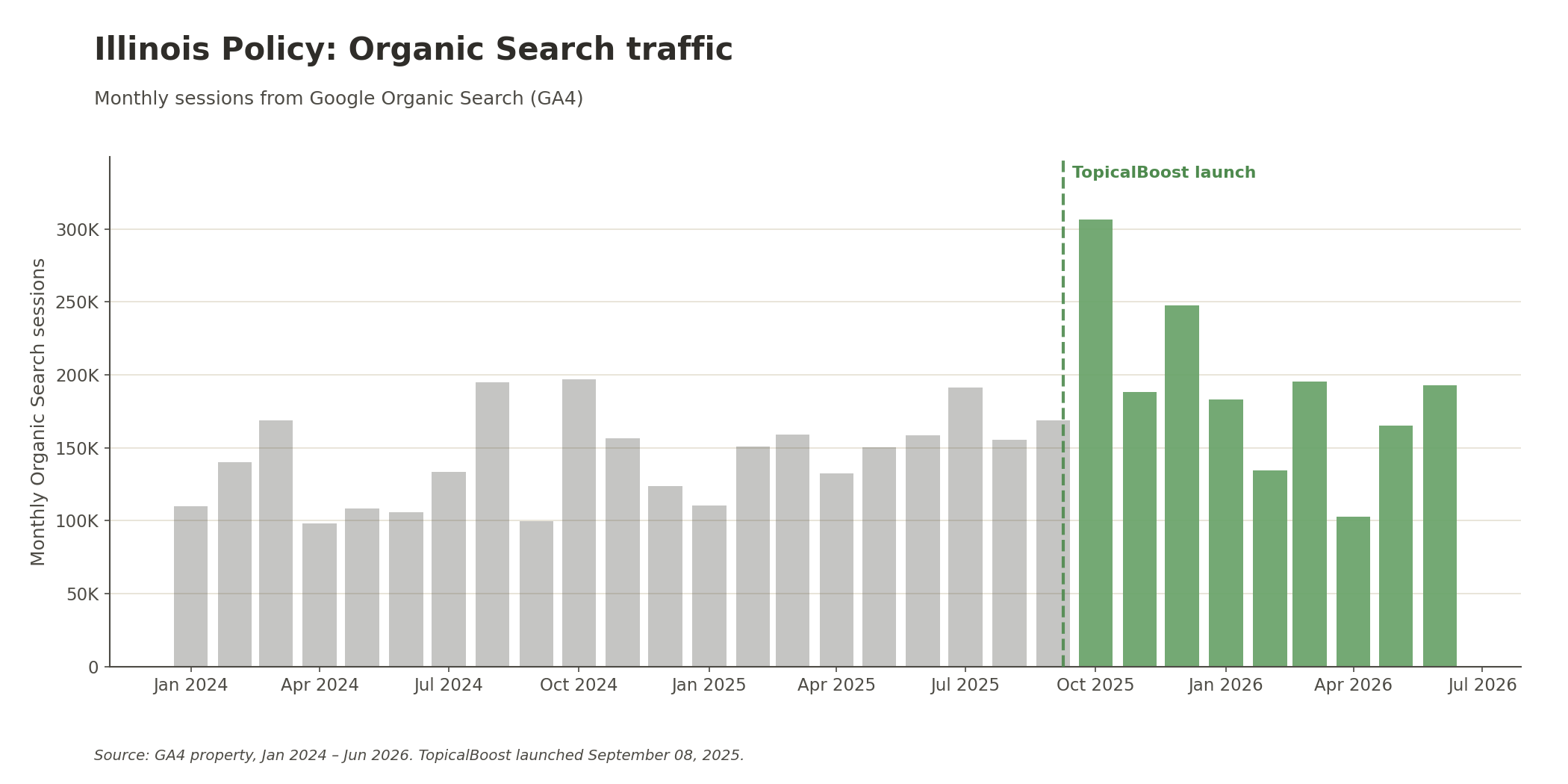
In the ten months before TopicalBoost, Illinois Policy generated 1,488,000 organic search sessions. In the ten months since, they generated 1,884,000. That’s a 27% sustained increase over nearly a full year.
Google Search Console tells the same story from a different angle:
- Monthly Search Console impressions rose from ~3 million before activation to a sustained 4–5 million per month, peaking at 6.8 million in January 2026.
- Keywords ranking in Google’s top 3 grew 76% year-over-year—from 1,332 in February 2025 to 2,346 in February 2026—and remain near 2,000 through June 2026.
This isn’t a spike that faded.
Monthly organic search sessions post-activation:
- 168K in September (partial month)
- 307K in October
- 188K in November
- 248K in December
- 183K in January
- 135K in February
- 195K in March
- 103K in April
- 165K in May
- 193K in June
Month-to-month traffic varies with the news cycle, but peak months exceeded any pre-activation month by 60%. October 2025 alone delivered 307,000 sessions—the highest-traffic month in the site’s 2.5 years of GA4 data.
3x Google Discover Traffic
This is where the case study gets interesting.
Before TopicalBoost, Illinois Policy averaged about 49,000 Google Discover clicks per month. Some months were higher—July 2025 hit 134,000 on the strength of a couple of viral articles. But most months landed between 28,000 and 51,000.
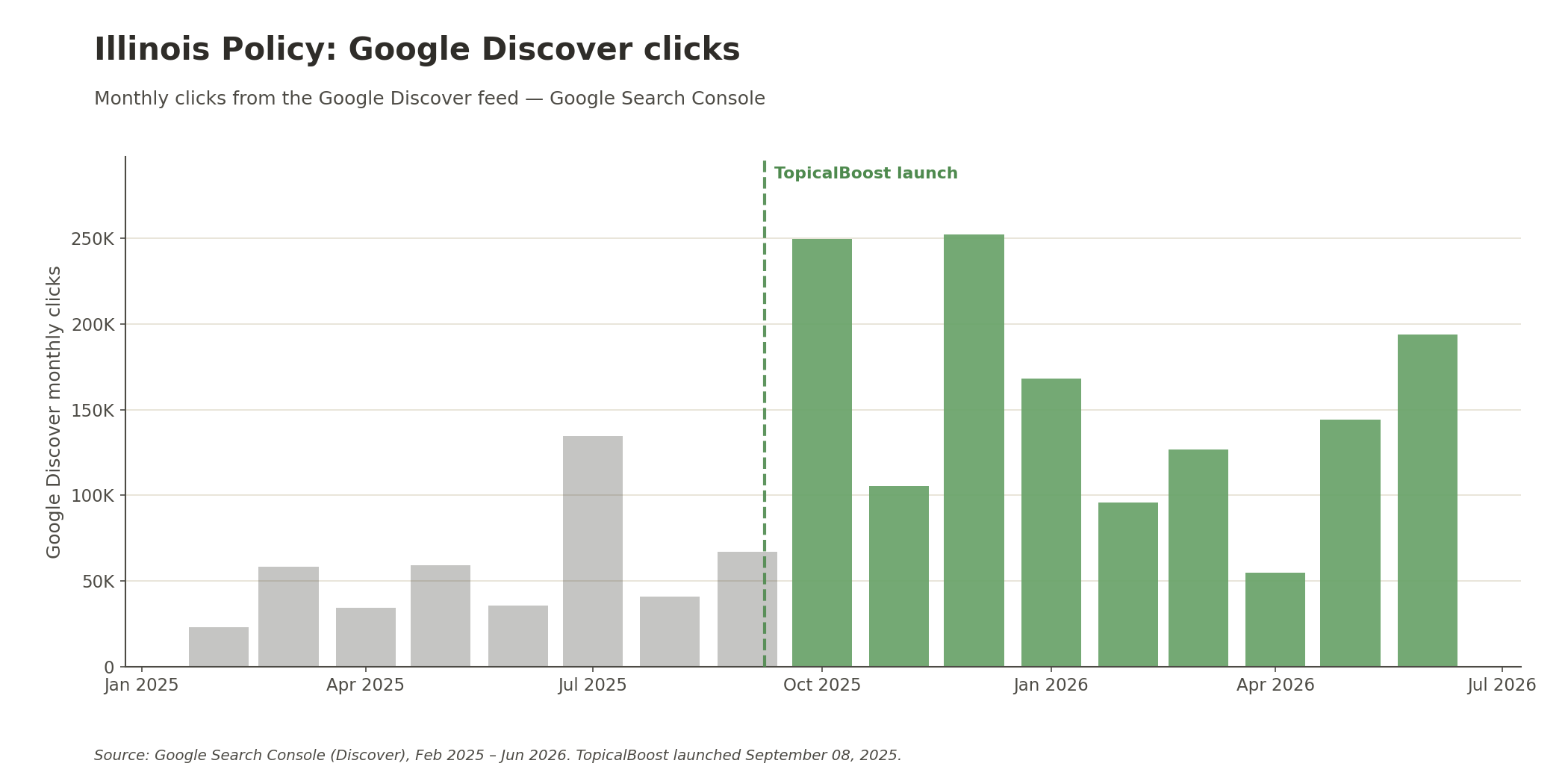
After TopicalBoost, they averaged 146,000 Discover clicks per month—roughly 3× the pre-activation baseline. October hit 250,000. December hit 252,000. Their single biggest Discover day, December 4, generated 55,822 clicks. Two articles drove that day: one about a proposed retirement tax and one about a failed universal basic income program. Neither was tied to a breaking news event. Google surfaced them because it understood what they were about and who would want to read them.
Before TopicalBoost, a 10,000-click Discover day was rare. After, it became routine.
The Compounding Pattern
The most important finding in this data isn’t the total numbers. It’s how the pattern changed over time.
In the early months after activation, Discover spikes were driven by single articles. On October 3, one article about Illinois taxpayers owing $38,800 in unpaid state bills generated 43,186 of the day’s 44,039 total Discover clicks. One article, 98% of the traffic.
By March 2026, the pattern had shifted. On March 5, the site generated 22,203 Discover clicks spread across four different articles: a statewide bag tax proposal (7,000), housing regulation changes (6,800), university funding disparities (5,000), and an income tax plan analysis (2,700). No single article dominated. Google was surfacing their coverage across multiple topics simultaneously.
This is what topical authority looks like in data. Each article that gets entity markup adds to Google’s understanding of what the site covers and how deeply it covers it. Early on, Google needs a standout article to justify surfacing the site in Discover. Over time, it develops enough confidence in the publisher’s topical coverage to recommend multiple articles at once.
The pattern held through mid-2026. On June 19, an article about a Chicago Teachers Union policy on locker rooms and gender identity pulled 58,712 Discover clicks in the days after publication. On June 22, an article about the largest toll hike in Illinois history added another 25,422. Two articles on two unrelated topics, both surfaced by Google to their respective audiences within days of publication. The compounding thesis predicts exactly this: as topical authority accumulates, Google gets more confident about surfacing new coverage the moment it lands.
A New Brand Discovery Path: Top Stories
Beyond organic search and Discover, a third source of traffic opened up: Google Top Stories, the news carousel that appears at the top of results for time-sensitive queries. In the eight months after activation, Illinois Policy appeared in 54 different Top Stories carousels—tied to queries with a combined 1.27 million monthly search volume. This include ranking at position 3 on “chicago” (594,000 searches per month), position 5 on “illinois” (201,000), position 1 on “jb pritzker” (69,000), and position 2 on “illinois tollway” (44,000).
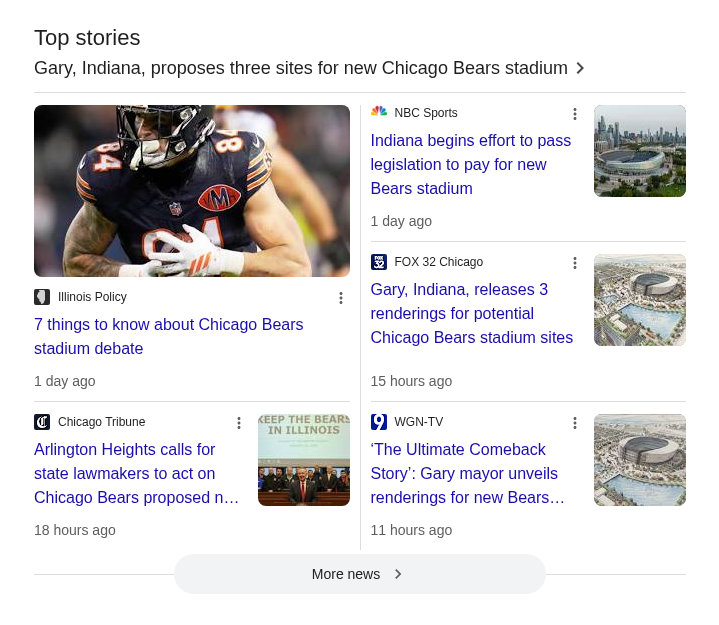
Before activation, Top Stories placements for Illinois Policy were rare. After, they became a regular way Google surfaces their reporting alongside major national and regional outlets.
We’ve seen the same multi-article surfacing pattern at other clients. It’s not unique to Illinois Policy. It’s what happens when entity markup compounds over months of consistent publishing.
Testing a Single Variable
The most important thing about this case study is what didn’t change.
Illinois Policy’s editorial team didn’t change their content strategy. They didn’t start publishing more frequently. They didn’t redesign the site or restructure their taxonomy.
The content they were producing before TopicalBoost is the same content they produced after. Articles about bread-and-butter issues in Illinois: property taxes, state budgets, pension reform, school policy, Chicago politics. The same topics, the same quality, the same frequency.
The only thing that changed was the structured data layer. TopicalBoost identifies entities in each article, connects them to Google’s Knowledge Graph through Schema.org markup, generates optimized titles and meta descriptions informed by real-time search traffic data, and builds internal links to topic archive pages. It gives Google a machine-readable map of what the site covers and how every article connects to the broader topics the publisher writes about.
Illinois Policy was already doing the work. TopicalBoost gave Google a way to see it more clearly.
Compounding Growth
Ten months after activation, organic search traffic sits 27% above the pre-activation baseline, and Google Discover traffic averages roughly 3× the pre-activation level.
More importantly, the results are compounding. Google is surfacing more of their content, more often, across more topics. That pattern won’t stop reverse so long as the publisher keeps publishing and the entity markup keeps building.
Illinois Policy didn’t need TopicalBoost to be a good publisher. They needed it to make sure Google understood just how good they already were.