
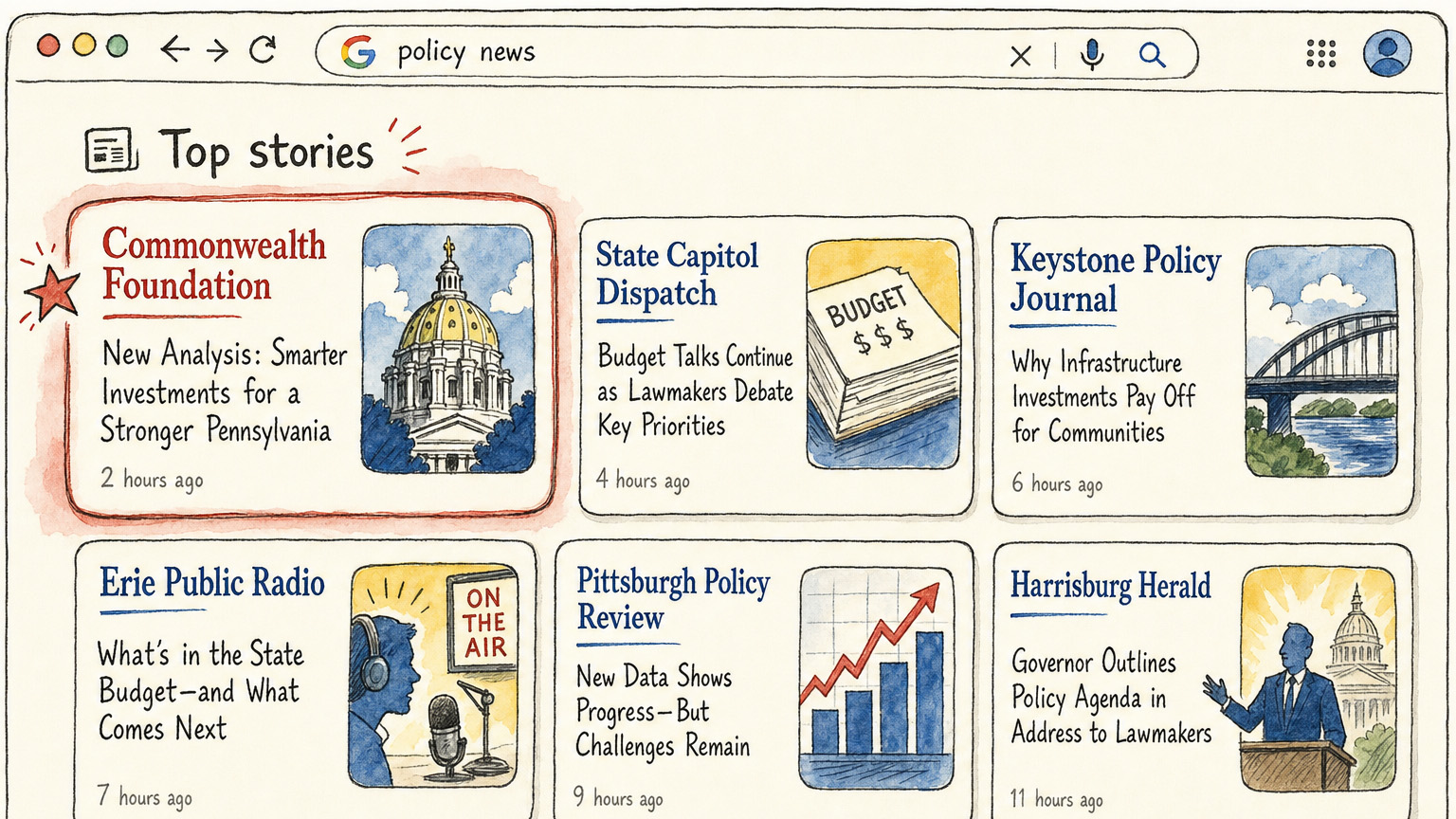

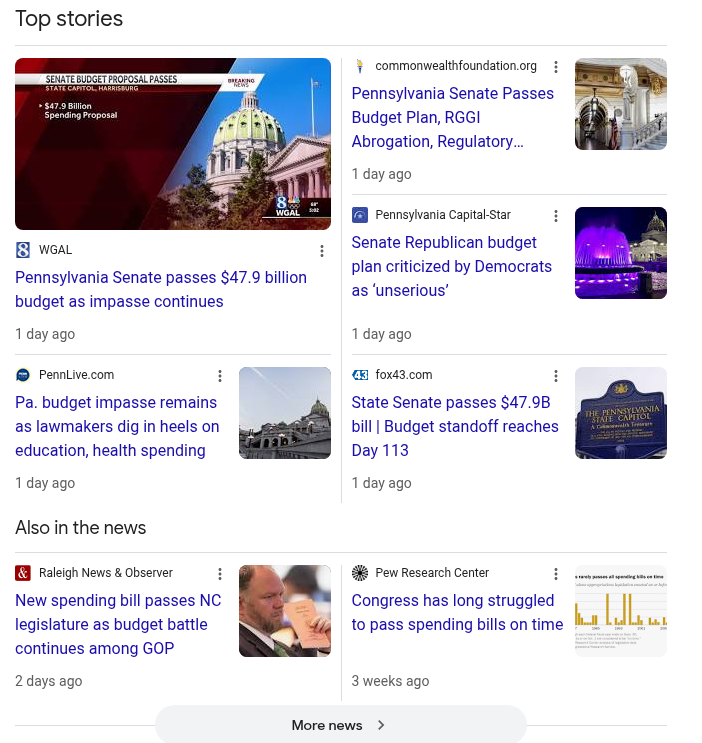
On October 22, 2025, Pennsylvania’s Senate passed a $47.9 billion budget proposal. Within 48 hours of the vote, Commonwealth Foundation’s coverage of the bill appeared in Google’s Top Stories carousel five separate times, against five different queries, for a combined 67 hours of carousel time. Commonwealth’s analysis sat next to WGAL, PennLive, the Pennsylvania Capital-Star, and FOX43. For the query “budget passed,” Commonwealth held position 1 for a sustained 57 hours.
This wasn’t a one-off. Since June 2025, Commonwealth Foundation has been placed in Google Top Stories twelve times. Nine of those twelve appearances were at position 1 or position 2. In the twelve months prior to June 2025, Commonwealth didn’t appear in Top Stories features.
The shift didn’t come from a marketing campaign, a syndication deal, or a sudden surge in writing volume. It came from Google understanding, structurally, that Commonwealth Foundation is the kind of publisher it should consider for time-sensitive Pennsylvania policy stories. Here’s what that decision was based on.
What it took to get there
TopicalBoost activated on commonwealthfoundation.org on June 1, 2025. From that day forward, every new post Commonwealth published carried entity-level schema.org structured data and topic-archive internal links.
The structure does two things at once:
- It tells Google what each post is about at the entity level—which specific people, organizations, policies, and concepts the piece engages, mapped against Google’s own Knowledge Graph.
- It routes link equity through topic archive pages, so every post about Josh Shapiro links to a topic page that lists all pages that mention the governor. In this way, the newest posts mentioning Shapiro inherit the link authority of pages that mention him.
TopicalBoost essentially speaks the language of Google.
After the rollout, sessions in Google Analytics moved up incrementally—13,000 in June, 18,700 in July, 22,100 in August. A steady increase, but not a spike. From the outside, the deployment looked unremarkable. All the while it kept adding signals to Google’s index.
What rolled out that summer
On August 26, 2025, Google launched what it called the August 2025 Spam Update. The rollout took 27 days, finishing on September 22. The previous spam update, in December 2024, had taken 7 days. The August 2025 rollout was nearly four times longer.
Spam updates are typically targeted and short—a 27-day rollout suggested Google was doing something broader. SEO analysts who tracked the update agreed. Glenn Gabe, posting on X two days after the update began, described the losers as “programmatic, doorways, spinning content across pages targeting the same/similar topic.” These are the sites that lose when Google does a deeper re-weighting of what counts as a credible publisher.
The August 2025 Spam Update was almost certainly a re-weighting pass, not just a spam pass. It updated the scores Google holds at the publisher level, then re-ranked the index using the new scores.
The signals that got re-weighted
The 2024 Google Content Warehouse API leak confirmed the existence of several site-level attributes Google had previously denied. Inside the CompressedQualitySignals module was siteAuthority—the long-denied site-wide quality score. Alongside it were siteFocusScore, which measures how concentrated a site is on a specific topic, and siteRadius, which measures how far each individual page’s content deviates from the site’s core theme. Higher focus, lower radius, more topical authority. The leak also revealed site2vecEmbeddingEncoded—a compressed vector representation of the entire site’s content, used to compare pages against the site’s overall theme.
It would be too computationally expensive to recalculate these scores continuously. Instead, Google refreshes them during major update cycles. So when TopicalBoost adds entity tagging, structured data, and topic-archive links to every post Commonwealth publishes, those signals enter Google’s index immediately. But the score recalculation that reflects the signals happens on Google’s schedule. There’s always a lag between adding those signals to a site and seeing them reflected in ranking decisions.
The August 2025 Spam Update was Commonwealth’s first encounter with a deep re-scoring event after TopicalBoost activation. Three months of structured entity infrastructure went into the recalculation. The site came out of it with a sharper topical focus score, a tighter site radius, and a vector embedding that placed it firmly in the neighborhood Google needed to put it in—Pennsylvania state policy authority.
The chain reaction
The first Top Stories appearance came on October 1, 2025. “Governor Shapiro’s Failed Leadership Leaves Pennsylvania More Vulnerable in the Event of a Federal Shutdown” landed at position 2 for the query “governor of pennsylvania.” That query draws 4,100 monthly searches in the United States. It was the first time a Commonwealth Foundation page had ever been placed in a Top Stories carousel.
Three weeks later, Commonwealth’s analysis sat in Top Stories carousels for queries like “budget passed” (position 1, 57 hours sustained), “pennsylvania senators” (position 2, 4,400 monthly searches), and “pa state taxes.”
In mid-November, three more Top Stories appearances landed for “Gov. Josh Shapiro Still Ain’t ‘Getting Sh*t Done'” and the related report—including position 1 for “governor josh shapiro,” a 1,500 monthly-search query.
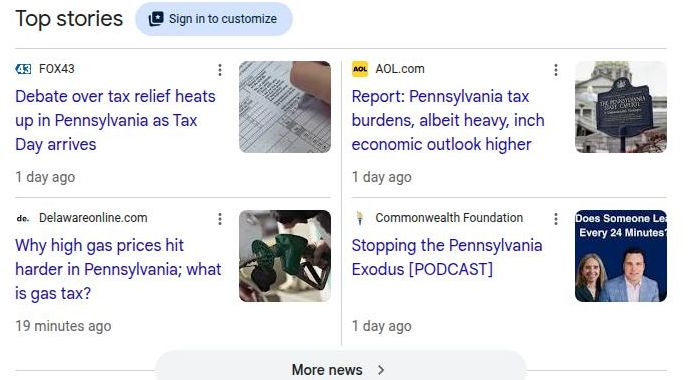
The pattern continued into 2026. On April 17, a Commonwealth podcast titled “Stopping the Pennsylvania Exodus” appeared in Top Stories at position 4 for “pennsylvania taxes.” Same carousel as FOX43, AOL.com, and Delawareonline.com.
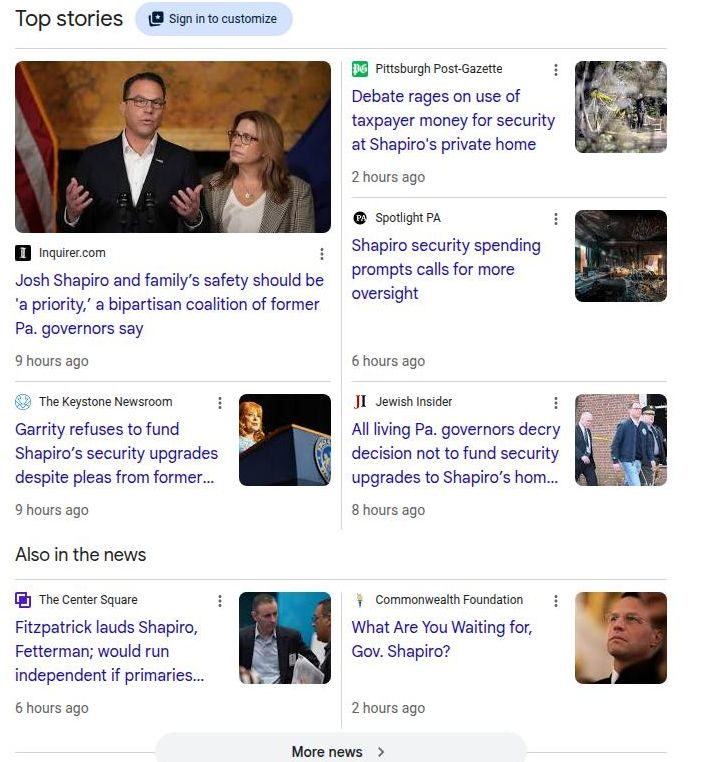
On April 28, “What Are You Waiting for, Gov. Shapiro?” landed in the carousel for “shapiro,” an 18,000 monthly-search query. Sharing the carousel: the Philadelphia Inquirer, the Pittsburgh Post-Gazette, Spotlight PA, the Keystone Newsroom, and Jewish Insider.
Twelve Top Stories appearances total since activation. Nine of those at position 1 or position 2.
Why Top Stories needed the structural work first
Top Stories don’t work like regular web results. Regular ranking lean heavily on backlinks and user interaction signals. But a news story has hours (or maybe a day or two) of search relevance. There simply isn’t enough time for Google to crawl links to a fresh story to determine if it’s authoritative. And while user interaction signals can help to promote or demote a Top Stories placement, they can’t be used to decide what initially appears in that carousel.
Because it can’t use real-time signals, Google ends up relying on a publisher’s site-wide identity to determine Top Stories eligibility. Newzdash, a news SEO tool maker, puts it this way in its publisher guide to Google News optimization:
To reduce the visibility of fake news and misleading information, Google has placed more emphasis and stronger weight on displaying results from authoritative news sites.
Google’s own How News Works documentation echoes this, framing “source authoritativeness” as one of the primary ranking factors.
This is why a site-wide score recalculation matters for news placement. When Google recalculates siteAuthority, siteFocusScore, and the site embedding, every future news story from that publisher inherits the new evaluation. A think tank that Google has just re-scored as a tightly-focused Pennsylvania policy authority is the type of publisher Google will elevate to Top Stories.
Once placed there, a publisher still has to preform. User engagement signals refine what stays in the carousel and what gets dropped. But the biggest hurdle is getting into Top Stories in the first place. That requires the right site-wide authority signals. Those values changed for Commonwealth during the August 2025 Spam Update.
The volume that came with it
Top Stories appearances were the most visible outcome of launching TopicalBoost, but Commonwealth also saw traffic measured by Google Analytics peak in November 2025 at 53,261 sessions—more than four times the pre-activation baseline.
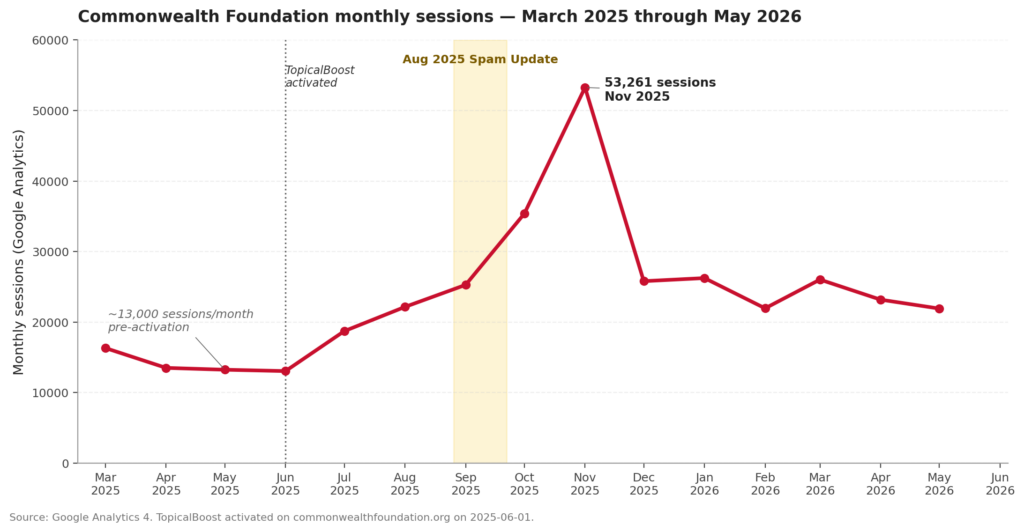
Last month, sessions were still running about 22,000 a month, holding at 65% above the pre-activation levels even outside of any news-cycle-driven spikes.
Top Stories placements drive volume, but so do broad ranking improvements that come from a sharper site identity in Google’s index. The two reinforce each other.
Becoming front-page news
When a Pennsylvania budget story breaks now, Commonwealth’s coverage appears in the same carousel as the Inquirer, the Pittsburgh Post-Gazette, WGAL, PennLive, and Spotlight PA. Editors and policy analysts who write for Commonwealth see their work sitting next to the biggest news brands in the state. Supporters and policymakers open their phones and see Commonwealth on the front page of Pennsylvania news on the issues Commonwealth was founded to cover.
If you run a publication with a clear editorial focus and a real publishing pace, your site is already most of the way there. Commonwealth’s results came from pairing disciplined editorial output with the entity infrastructure TopicalBoost adds to every page on the website, then waiting for the next major update to recalculate.
A 20-minute walkthrough of what the same arc could look like for your site is the most useful next step. Schedule a call, or read more case studies from publishers running the same approach—Carolina Journal and Illinois Policy are two recent stand-outs.
Front-page news is the result of structural change. What has your archive been telling Google about your publication?