


Rankings aren’t a business result. They don’t pay the bills, they don’t fill the CRM, and they aren’t what a publisher’s board asks about at the quarterly meeting. Traffic is. Revenue is. Rankings are a step or two removed from either.
But rankings are the one effect of a SEO intervention we can measure the same way across every TopicalBoost install. While I’d prefer to measure traffic, traffic depends on two things we don’t control:
- What the customer publishes
- What the world happens to be searching for that week
A publisher’s traffic can jump to 5x its normal level when their beat lands on the front page of a political story. Same content, same site, same rankings—the world just starting searching for their thing. And traffic can crater for reasons that have nothing to do with the site itself.
Rankings, by contrast, are demand-independent. They measure your content against everyone else currently competing for the same queries and they’re relatively stable, at least over the medium term of weeks or months.
That’s why I’ve index our portfolio on rankings here. Not because rankings are the outcome we’re seeking, but because we can compare them across publishers. Below I’ve done that with eight TopicalBoost customers with sites that have an Ahrefs Domain Rating of 70 or higher. I’ve indexed them to each site’s own pre-launch baseline and provided eighteen months of rankings before activation through twelve months after.
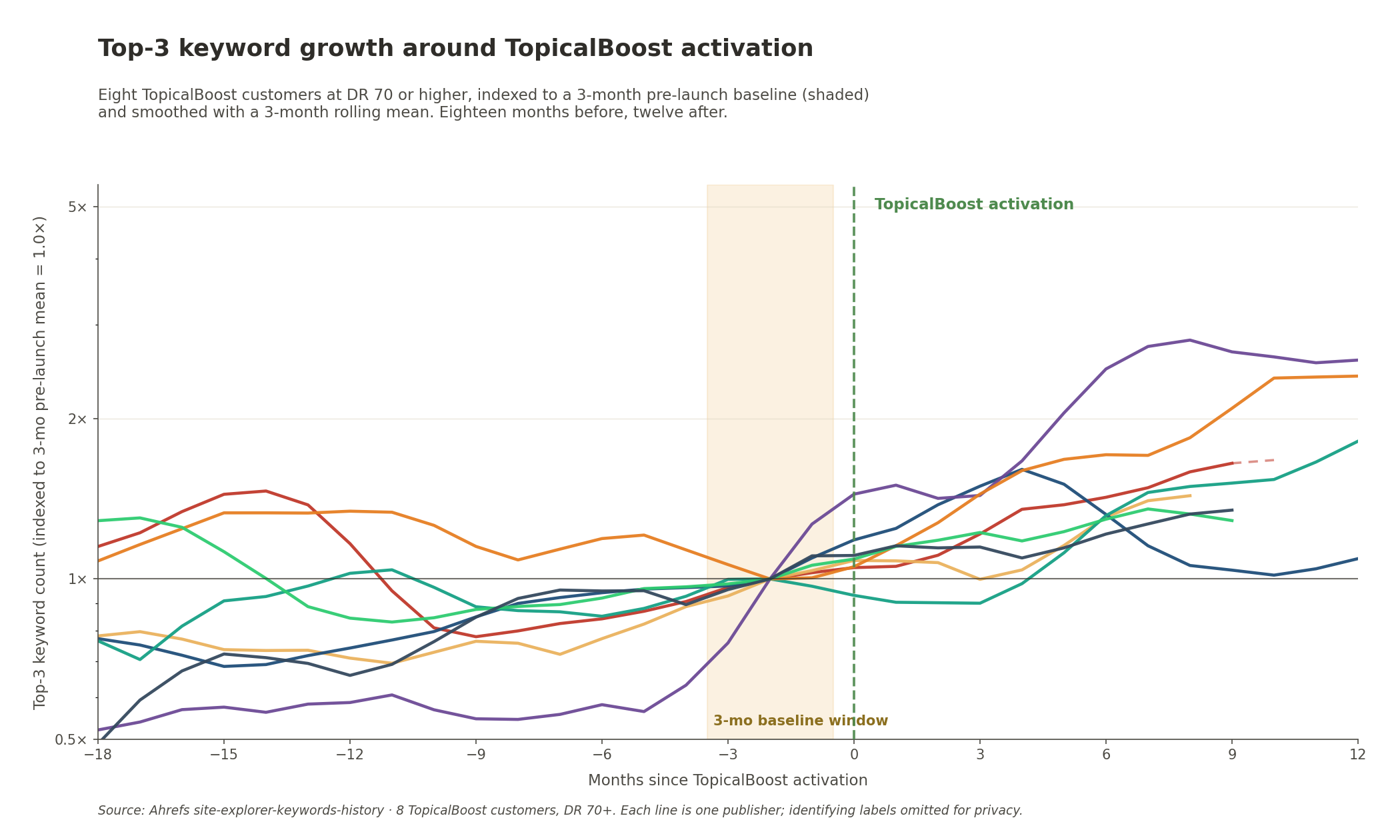
Each line is one publisher. Each publisher is indexed to their own three-month pre-launch average, so a value of 1.0 means the site has the same top-3 keyword count as the average of the three months before we turned TopicalBoost on. A value of 2.0 means the site has twice as many top-3 keywords now as it did in that pre-launch window. The green dashed line marks activation.
Most of the lines move up. A few move materially. Two stay close to the 1.0× line for the full post-launch window.
Here’s the same portfolio measured on top-10 rankings rather than top-3.
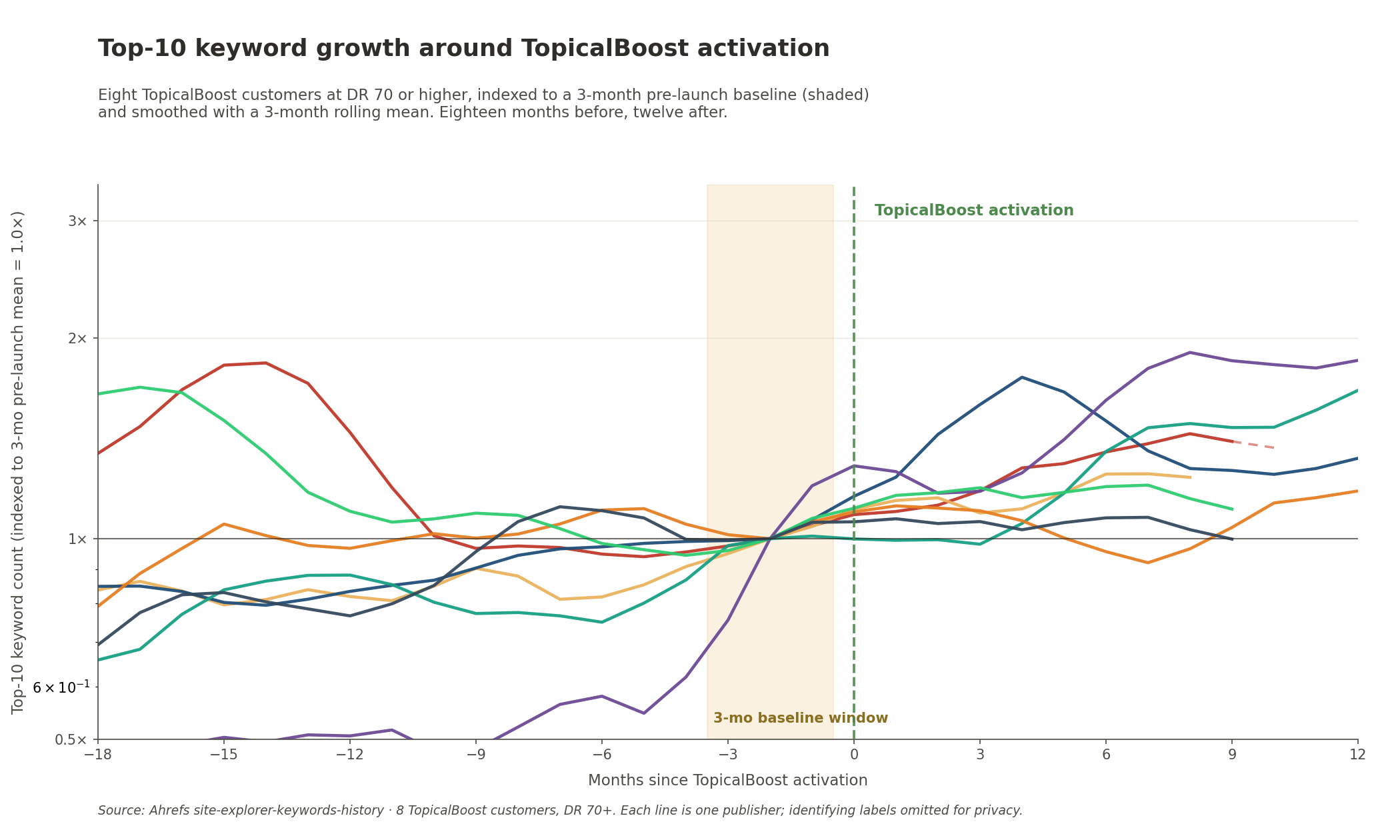
Similar shaped results.
A small methodological note on both charts: we use top-3 and top-10 keyword counts specifically, and not average keyword position, because Google removed the num=100 search parameter in September 2025. That change broke the historical basis for every average-position dataset that spans that date, ours and every SEO tool’s included. Top-3 and top-10 counts are unaffected because the SERP itself still surfaces the top 10 the same way. If a publisher tells you their average position dropped meaningfully in October 2025 or later, the first thing to check is whether the drop is real or an artifact of the num=100 change.
About those two flat lines
If you’re wondering why the bright green and black lines stay closer to the 1.0× baseline than the others, the answer isn’t that TopicalBoost didn’t work for those publishers. While both saw modest improvements in top-3 and top-10 keyword counts after activation, what TopicalBoost did for them landed somewhere other than rankings.
Those two lines belong to Illinois Policy (green) and Carolina Journal (black). Both have published case studies on this site.
Illinois Policy’s monthly Google Discover clicks moved from around 49,000 pre-launch to around 146,000 post-launch, peaking at 252,000 in a single month. That’s 3x difference. Discover doesn’t work like organic search, though. Lily Ray, one of the most-cited practitioners writing about Discover, put it plainly in Search Engine Journal:
Google Discover curates a personalized feed of content for users based on their interests, search history, location, and activity in other apps… Traditional SEO includes the use of keywords… but the content strategy in Discover should be based on entities.
There is no query in Discover. Google assembles the feed entity by entity. Which entities a given user sees depends on what Google thinks that user is interested in, and which publishers show up on for entities depends on which publishers Google thinks are authoritative on them.
That topical authority evaluation runs at the site level, not the post level. Google’s John Mueller f described this in a Search Central hangout, captured by Search Engine Roundtable:
For search engines you’re kind of building out your reputation of knowledge on that specific topic area… If we can recognize that this website is really good for this broader topic area then if someone is searching for that broader topic area we can try to show that website as well. We don’t have to purely focus on individual pages.
Site-level topic reputation is the mechanism Lily Ray is describing for Discover. John Mueller confirms it for search more broadly.
Like a lot of SEO practices, TopicalBoost’s job is to make explicit what might otherwise get inferred. Rather than trusting that Google’s natural language processing will flawlessly detect that a publisher has written many times about a topic and connect the dots on its own, TopicalBoost builds those connections into the architecture of the site. Every article carries explicit entity tags on publish. The site gets topic archive pages that internally link out to every post about each topic. Google walks the internal-link graph and reads the topic pages as authoritative indexes of the publisher’s coverage.
Illinois Policy’s archive has 556 posts tagged Chicago Teachers Union, 572 tagged JB Pritzker, 348 tagged Brandon Johnson, 352 tagged Medicaid. Hundreds each on Cook County, the Illinois General Assembly, the Illinois Supreme Court, the state Constitution, and a dozen more of their core beats. The Discover traffic generated corresponds to this depth of coverage:
| # | Article | Clicks | Impressions | CTR |
|---|---|---|---|---|
| 1 | Illinois taxpayers each owe $38,800 for state’s unpaid bills | 71,383 | 645,875 | 11.05% |
| 2 | Tollway pushes largest toll-tax hike on drivers in Illinois history | 62,658 | 716,663 | 8.74% |
| 3 | Chicago Teachers Union overrides state law on locker rooms, gender identity | 58,927 | 539,010 | 10.93% |
| 4 | Handing out money without work fails — but Illinois trying it again | 53,515 | 495,932 | 10.79% |
| 5 | Illinois lawmakers push retirement tax to keep spending more | 52,167 | 440,786 | 11.83% |
Depth of coverage existed before TopicalBoost. What changed is that Illinois Policy stopped asking Google to figure out the topic structure of the archive and started giving Google an explicit map.
Carolina Journal’s story is the same mechanism playing out on a different part of Google’s index. Their Google Top Stories appearances grew from 22 to 110 in matched seven-month windows around activation, with 74 of those appearances at position 1 or 2, like in this example where it appeared for the search term “dnc” alongside Newsweek, Fox News, and CNN:

Top Stories is another site-level topical-reputation call. Same mechanic, different outcome.
If you only look at top-3 or top-10 keyword counts, you’d conclude Illinois Policy and Carolina Journal saw small wins. What actually happened is that both publishers earned large amounts of high-value visibility on the parts of Google’s index that rely almost solely on site-level topical reputation rather than page-level query matching.
What these charts say
These charts show a capability that produces a measurable, portfolio-wide signal across publishers of varying sizes, editorial focuses, and news cycles. It isn’t a promise about what any individual publisher will see. Results depend on how much of the site’s coverage overlaps with high-competition queries, how quickly the site’s classification stabilizes in Google’s index, and what else the publication is doing on SEO and editorial.
Some of the sites in this chart are still ramping. Some are already at ceiling on the queries they care most about. The chart captures the shape of a pattern, not the ceiling of any one line.
That’s the measurement layer. In the next post in this series, we’ll get into what’s underneath it—the specific capabilities TopicalBoost gives editors, and what it looks like when a publisher uses them to correct how Google reads their pages.